
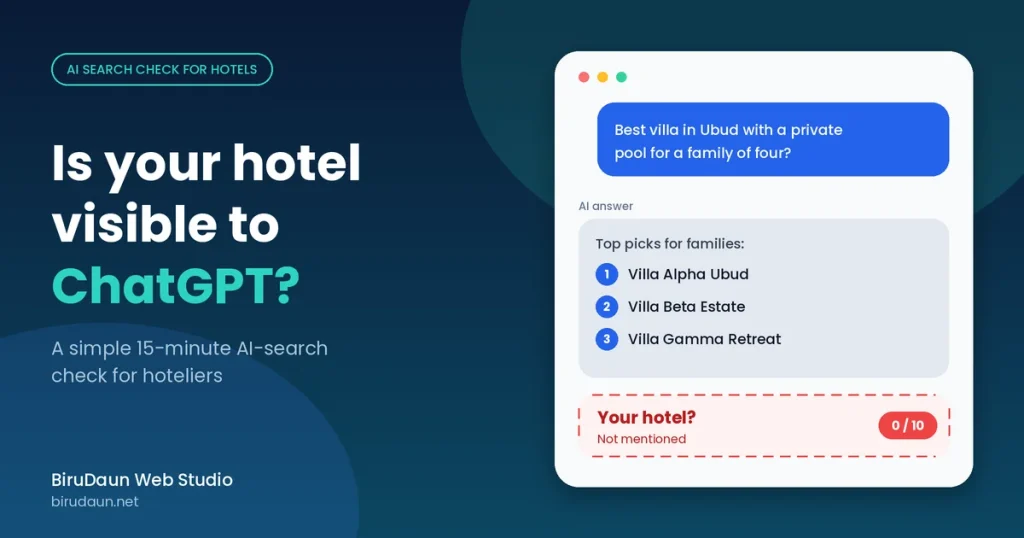
A guest in Sydney opens ChatGPT and types: “Best villa in Ubud with a private pool for a family of four.” Within seconds she gets a short list of three or four properties, with reasons. She never opens Google. She never scrolls through OTA (Online Travel Agent). If your villa is not on that list, you lost the booking before you knew it existed.
This is no longer a rare scenario. Phocuswright research, reported from the HITEC 2026 conference, found that 56% of travelers had used AI for trip planning, booking or in-destination help in the previous 12 months. Your guests are already asking AI where to stay.
The good news: you can check your own visibility in about 15 minutes, for free, without any special tools. This guide shows you how.
Why a good Google ranking is no longer enough
Google shows a list of links. AI tools such as ChatGPT, Gemini and Perplexity do something different: they write one answer, built from many sources at once. These include your website, your Google Business Profile, OTA listings, review sites, blogs and travel forums.
That means a hotel can rank well on Google and still be missing from AI answers, or be described with outdated or wrong information. And when AI does recommend a property, the guest often goes straight to the booking link it suggests. Often that is an OTA, not your direct site.
The 15-minute AI-visibility check
Open ChatGPT, Google Gemini and Perplexity in separate tabs. Use a private or logged-out window so your own history does not bias the results. Then ask these five questions, replacing the details with your own property:
- Discovery: “What are the best boutique hotels in Seminyak for couples?” (use your area and guest type)
- Brand check: “Tell me about [your hotel name] in [location].”
- Suitability: “Is [your hotel name] good for families with young children?”
- Booking: “Where is the best place to book [your hotel name]?”
- Comparison: “Compare [your hotel name] with [a competitor] in [location].”
Run each question once in English and, if you serve Indonesian guests, once in Bahasa Indonesia. Guests from Australia, Europe and Asia often ask in their own language, and results can differ.
How to score your results
Give each of the five questions a score from 0 to 2:
- 0: Your property is not mentioned, or the answer is wrong.
- 1: You are mentioned, but the details are inaccurate or incomplete, or the answer points only to OTAs.
- 2: You are mentioned with accurate information, and your own website is referenced or linked.
Add up the points (maximum 10):
- 0-3: Invisible. AI tools barely know you exist. Start with the fixes below.
- 4-7: Partly visible. You show up, but competitors or OTAs are taking the credit. There is clear room to improve.
- 8-10: Strong. Keep your information consistent and check again monthly.
Write down the date and your score. AI answers change over time and can vary slightly each time you ask, so treat this as a snapshot, not a ranking. Run each question twice if you want a fairer picture.
Why hotels score low, and what to fix
1. Your website says too little in plain text. Many hotel sites rely on large images, sliders and text baked into pictures. AI tools read text. Make sure every room type, facility, location detail and policy is written out clearly on the page.
2. Your information is inconsistent. If your name, address, amenities or star rating differ between your website, Google Business Profile and OTA listings, AI tools are less likely to trust any of them. Pick one correct version and update everywhere.
3. You have no FAQ answering real guest questions. Guests ask things like “Is there airport pickup?”, “Is the villa suitable for toddlers?” or “What is the cancellation policy?” A clear FAQ page gives AI tools ready-made answers, and those answers point back to you.
4. Search crawlers may be blocked. Check your robots.txt file and your security settings. Some sites accidentally block the crawlers that AI search tools use, which makes them invisible. Your web developer can check this in minutes.
5. Missing structured data. Schema markup is a hidden layer of code that labels your content (“this is a hotel, this is the address, these are the rooms”). It helps both Google and AI tools understand your property. We will cover this in detail in an upcoming article.
6. Few or old reviews. AI tools draw heavily on what guests say about you. Keep collecting recent reviews on Google and on the platforms your guests use, and reply to them.
7. A slow or hard-to-use mobile site. Even if AI sends a guest to your site, a slow page or a confusing booking form will send them straight back to an OTA.
Five quick wins you can do this week
- Run the five-question check and save the answers as screenshots.
- Fix any wrong facts on your Google Business Profile (hours, address, amenities, photos).
- Add or expand a FAQ page with at least 10 real guest questions.
- Make sure your room descriptions and location details are written as text, not only inside images.
- Put your direct-booking advantages (best rate, free breakfast, late checkout) clearly on your homepage.
Frequently asked questions
Is AI search the same as SEO? They overlap. Good SEO (clear content, fast pages, accurate local listings) helps both. But AI search also rewards consistent information across many sources, and structured, easy-to-quote answers.
Does ranking first on Google mean ChatGPT will recommend me? No. They use different methods, so a top Google ranking does not guarantee a mention in AI answers.
How often should I run this check? Once a month is enough for most properties. Check again after any big website or listing change.
Do I need special software? No. The check above uses free tools. Paid tools can track results over time, but they are not needed to start.
Want us to run the check for you?
BiruDaun Web Studio has built websites and booking engines for hotels and villas across Bali and Indonesia. We offer a free AI-visibility check for your property: we run the questions, score the results and tell you the three fixes that matter most.
Message us on WhatsApp at +62 812 4646 007 to get started.